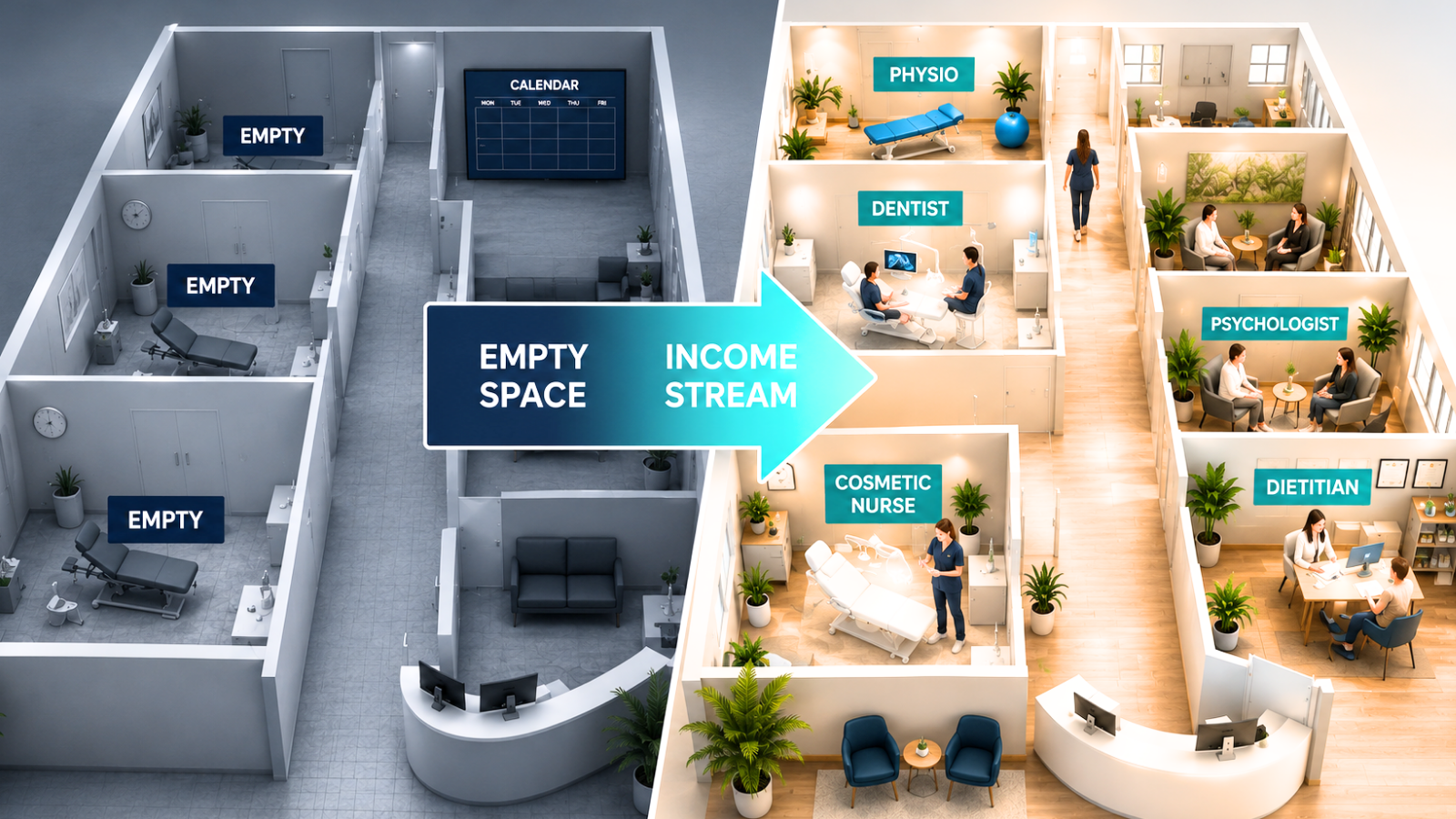
The Standalone Clinic Is Being Re-Written: : The Rise of Australia’s Healthcare Hub
The traditional one-practitioner, one-speciality clinic model is being challenged. Across Australia, healthcare delivery is moving towards more integrated, multidisciplinary environments - and that shift could change how clinic owners think about underused space.
For decades, healthcare businesses largely operated in isolation.
A GP occupied one premises. A physiotherapist leased another. A psychologist worked nearby. Patients travelled between providers, while each clinic carried its own rent, utilities, fit-out and operating costs.
That model is changing.
The healthcare hub is gaining ground.
Healthcare hubs bring multiple disciplines together in one location.
A single site may include GPs, physiotherapists, psychologists, dietitians, podiatrists, specialists, pathology and other allied health providers.
The Australian Government’s Strengthening Medicare Taskforce has identified multidisciplinary team-based care as an important part of improving primary healthcare, with the aim of reducing fragmentation and delivering more coordinated care.
Healthcare property is responding too.
Commercial Real Estate Australia reported in July 2026 that integrated healthcare hubs are attracting increasing interest, with operators combining services such as general practice, pharmacy, pathology, imaging, physiotherapy and rehabilitation under one roof.
The reasons are commercial as well as clinical: stronger referral pathways, patient convenience, better use of facilities and the ability to spread property costs across multiple users.
Your healthcare hub may already exist.
For clinic owners, the opportunity does not necessarily require building a large medical centre.
It may already be sitting inside the existing clinic.
Consider a four-room practice where only two rooms are consistently occupied.
The vacant rooms still contribute to rent, electricity, insurance, cleaning and other fixed overheads.
Instead of viewing that room simply as spare capacity, owners can ask a different question:
Could a compatible practitioner use it?
A physiotherapy clinic may accommodate a dietitian. A psychology practice may work alongside an occupational therapist. A medical clinic may host a visiting specialist several days each month.
One additional practitioner can potentially create rental income, strengthen referral networks and improve the utilisation of infrastructure that already exists.
The next healthcare property question...
Clinic owners have traditionally asked:
“Where should we open next?”
The smarter question may increasingly become:
“Are we fully using the clinic we already have?”
The future healthcare hub does not have to be enormous.
It could begin with:
One clinic.
One underused room.
One complementary practitioner.
Australia’s healthcare property model is changing.
And for many clinic owners, the opportunity may not require more space.
It may require using existing space better
Sources: Australian Government Department of Health and Aged Care, Strengthening Medicare Taskforce Report; Commercial Real Estate Australia, Evolution of Integrated Healthcare Real Estate Hubs, July 2026.